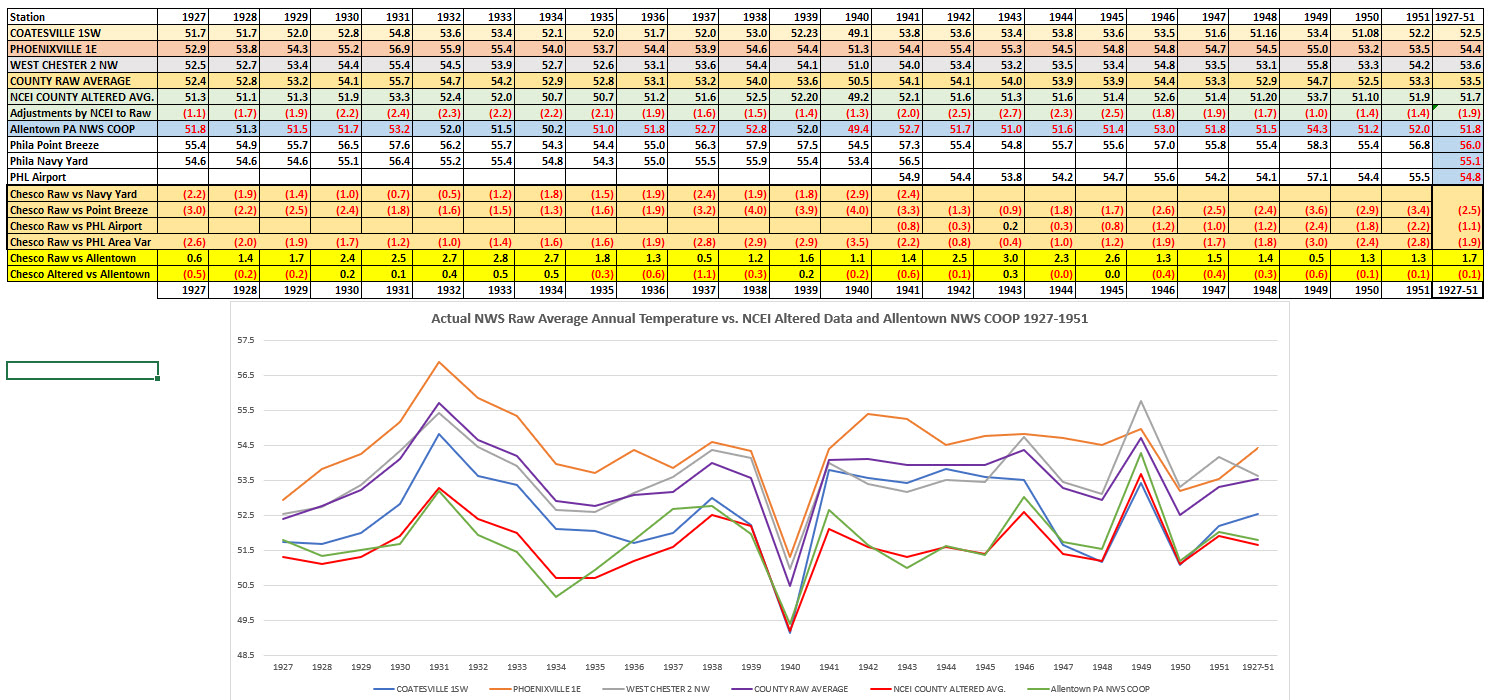
Actual Raw Temperature vs. NCEI Altered Estimated Data
The charts and analysis below show the differences between the observed raw data (see blue in charts below) as recorded by trained National Weather Service Cooperative Observers versus the more recently made post hoc estimated adjustments (see red in below charts) developed by NOAA to adjust that raw data. NOAA adjusts its climate data based on estimates to create what they believe will represent a consistent and accurate record by correcting for changes that would otherwise obscure long-term trends, such as instrument changes, station relocations, and the urban heat island effect.
You will see both this estimated adjusted and actual raw data presented under this section. The development of the estimated adjusted data takes the actual raw data recorded by the trained National Weather Service observers and attempts to identify and estimate the impact of various kinds of data quality problems by comparing each time series to a neighboring station. Of note these stations were in the case of Chester County PA not located anywhere within Chester County at all! In fact see the chart below we found that NCEI adjusted all of Chester County to an average annual temperature lower than that recorded 40 miles north of the County at Allentown PA. At the end of the analysis the “adjusted data” is created as an estimate of what the weather at this location might have looked like after removing apparent biases. This estimated “adjusted” data is proposed to be generally free from quality control issues and be regionally homogeneous. Some users may find this estimated data that attempts to remove apparent biases more suitable for their needs, while others including this Chester County Climate site may indeed prefer to work with the actual original raw values.
Lastly, the adjustment process provides a “regional expectation” estimation series, based on the expected estimated temperatures in the neighborhood of the station. This incorporates information from as many weather stations as are available for the local region but in this situation not even within the same county of the actual NWS cooperative observers location. Note that the regional expectation may be a systematically a bit warmer or colder than the weather stations by a few degrees due to differences in mean elevation and other local characteristics. The clear impact of this NOAA estimated adjusted data has resulted in cooling of the past raw data and is now warming the recent years. These alterations based on the estimated data have led to an exaggeration of the warming trends observed as in reality our warmest decades here in Chester County back in the 1930’s and 1940’s.